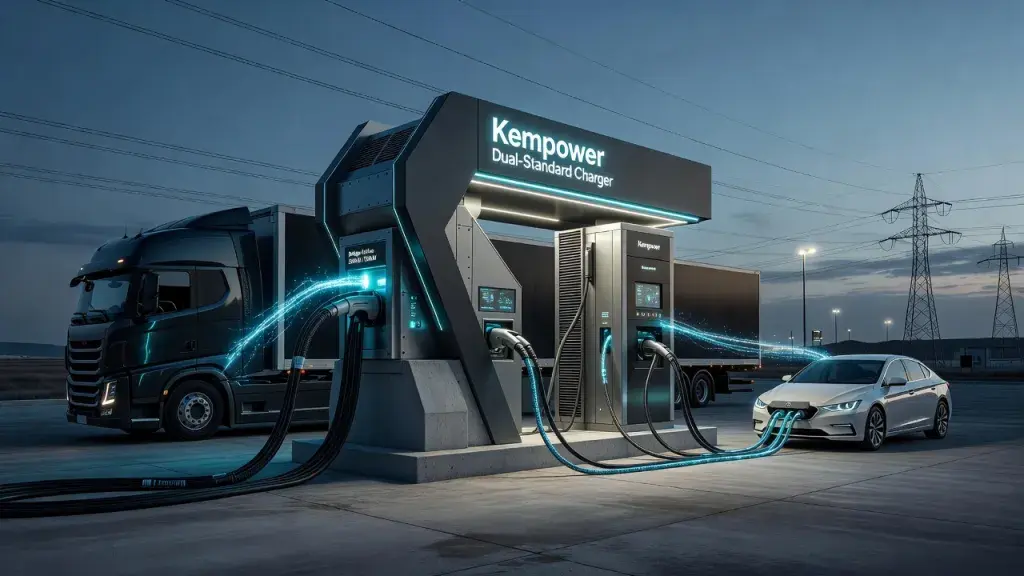
A single charging dispenser that can fuel both a passenger sedan and a heavy-duty truck at radically different power levels is no longer a concept on a slide deck. Kempower has unveiled the Mega Satellite Flex, a charger capable of delivering up to 560 kW through the established CCS standard or up to 1.2 MW through the emerging Megawatt Charging System, marking the company's first product built to serve both formats from a single unit.
The timing reflects a real inflection point in electric transport infrastructure. CCS remains the dominant connector for electric cars worldwide, while MCS is only beginning to appear at depots and corridor stops designed for freight trucks that need to recharge massive battery packs quickly to stay on schedule. Building separate hardware for each standard has been the default approach, but it doubles costs and complicates site planning for operators trying to serve mixed fleets. This kind of infrastructure debate has parallels in other corners of digital and physical connectivity, where standards fragment before eventually converging - much as travelers researching regional access restrictions might look into using a VPN in Saudi Arabia to navigate a patchwork of rules rather than juggling multiple separate tools. using a VPN in Saudi Arabia
What the Hardware Actually Offers
The specifications point to a charger built for flexibility rather than a single narrow use case. The Mega Satellite Flex supports up to 1,500 amps on the MCS side and 700 amps for CCS, with cable lengths of 5 meters for CCS sessions and 2.7 meters for MCS connections - a detail that matters more than it might seem, since truck charging ports and car charging ports sit in different positions on a vehicle. An optional payment terminal allows the unit to serve public or semi-public sites without additional hardware bolted on afterward. It also draws on Kempower's existing distributed charging architecture, meaning operators already running Kempower systems can add the new dispenser without redesigning their electrical or software infrastructure.
Why Utilization Is the Real Story
Charging hardware is expensive to install and slow to earn back its cost if it sits idle. A site that can only serve cars misses the truck traffic that increasingly needs high-power stops along freight corridors, and a site built only for MCS trucks wastes capacity whenever no heavy vehicle is present. By supporting both standards on one dispenser, Kempower is betting that operators will see higher and steadier utilization from the day a site opens, rather than waiting years for truck traffic to justify a second, separate installation. The addition of support for 800-volt vehicle architectures - increasingly common in newer EV platforms - extends that same logic to passenger cars that can already accept faster charging speeds than older 400-volt systems allow.
A Signal for the Broader Industry
Kempower revealed the Mega Satellite Flex at its Unplug & Recharge event held alongside ACT Expo, a venue closely watched by fleet operators and charging network developers. The product will not reach North American and European markets until July 2026, giving the industry over a year to assess how MCS deployment actually unfolds before the hardware ships. That gap matters: MCS is still a young standard, and real-world adoption will depend on truck manufacturers, charging networks, and grid operators aligning on rollout timelines. A dual-standard dispenser reduces the risk of stranded investment for site owners who are uncertain which vehicles will show up first, and it offers a practical answer to a question that has quietly shadowed the switch to electric freight - whether infrastructure can be built once, correctly, instead of twice.